Tuesday, November 22, 2011

The World in 50 years


The Mayas predict the end of the world for the year 2012, but even if we survive another year, can we hope something for our future?
Fifty years from now, men might have changed their habits and might protect the planet Earth. Maybe the planet Earth will be the nicest place to live in the entire universe or maybe we’ll have to deal with the Martians, I don’t know.
Maybe we’ll forget the meaning of the word “crisis” and the capitalist system will just be a bad memory for old veterans like us.
But 2060 could also be the start of a nuclear war between the United States and China (or others countries), which could destroy the entire planet and kill the entire population, who knows?


In my opinion;, I know that a lot of things could happen in fifty years, and not just bad things, as some of my friends think. I hope that our children will live in a better world than ours. Maybe I’m an eternal optimist and maybe I’m wrong but let me dream!


Saturday, November 19, 2011

Thirty years from now

Thirty years from now, I might be dead, I might be a musician, I might be a good father (or a drug dealer), who knows?
Nobody can predict his own future but I hope that I could fulfil my main dreams.
Thirty years from now, I hope that my lifestyle will be the same. At the age of 50, I would drink beers and play music with my friends, even if some of them might have great responsibilities and important jobs. Oldness shouldn't rhyme with boredom! I want to enjoy every moment with people I love.
My main wish is to become a professional musician and to travel the world thanks to music. Thirty years from now, I hope I played all over the world, especially in the United States, in Germany and in Japan.

Wednesday, November 16, 2011

Does war photography have a future ?

To answer this question, let's take a quick look at the war photography history. The first war images date from the Mexican-American war in 1847. In Europe, the first war pictures were taken during the Crimean War by several photographers like Carol Popp de Szathmari or Roger Fenton.


At this time there were few war photographers but war photography already raised a question: is war photography showing the reality of the war?
Some photographers from this time, like Alexander Gardner, recreated battle scenes to take better and clearer pictures.
This question about the reality was also a problem for the photographers of the 20th century, who covered all the majors conflicts in the world. One major change of the 20th century is that photographers can shot moving scenes thanks to the progress of the technology.
Photographers try to inform people, that's why some pictures become the best conflicts illustrations. During the 20th century, some photographers like Robert Capa or Joe Rosenthal became stars, well-known for their war pictures.
War photographer is still a dangerous job and some photographers died during reports, like the founder of the agency Magnum, Robert Capa.
Today, does war photography have a future?
One of the problem is that everybody can take pictures with a mobile phone, and these mobile pictures are published in newspapers. Video is also slowly killing photo, we can see more war scenes on Youtube then in newspapers, and war photography is still extremly dangerous, as we can see with the most recent conflicts.

Thursday, November 10, 2011

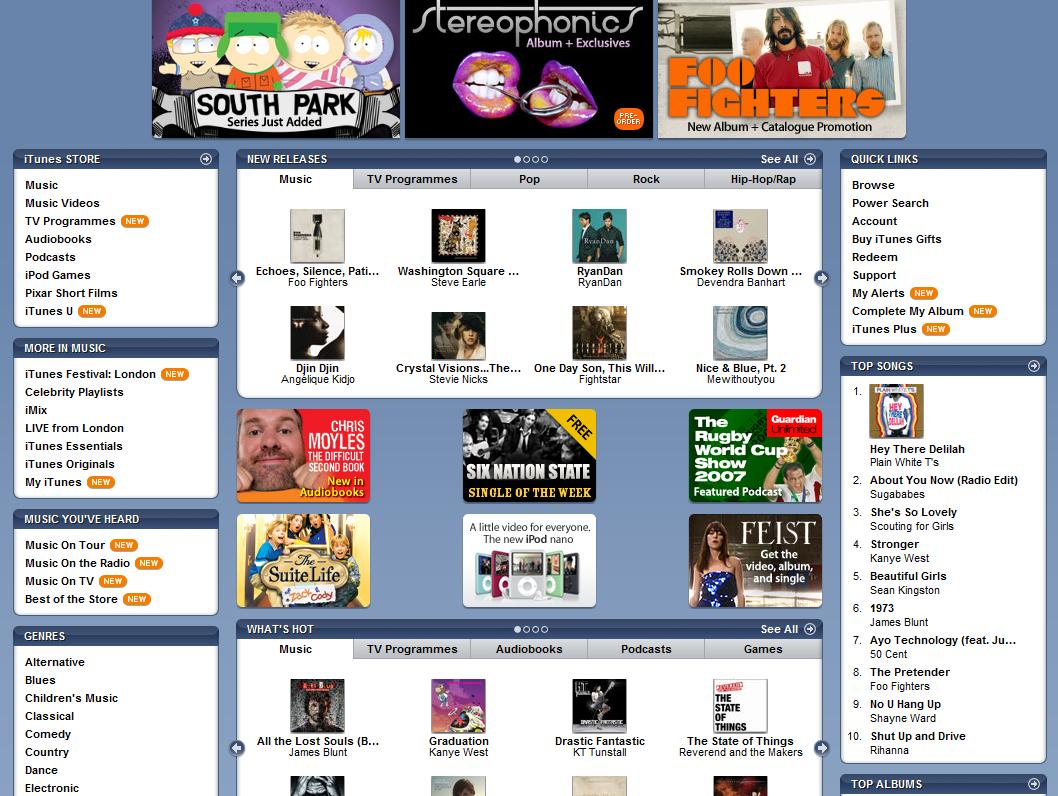
A quick look at the online music stores

 
The online music stores are different from music streaming services because it enable users to download songs (and not just listen to it).
In 1993, the first online music store, called Internet Underground Music Archive, was launched. Another important step is the foundation of Ritmoteca.com in 1998. This website had a a catalog of approximately 300 000 songs. Ritmoteca.com offered the possibility to download a single MP3 song for $0.99 and an entire album for $9.99. The site had distribution deals with four major labels: BMG (Bertelsmann Music Group), Warner, Universal and Sony Music.


With the emergence of services like Napster or Kazaa in the 2000's, the major labels decided to launch their own online music stores, but it was a great failure. For instance, on Sony's one, the user had to pay $3.50 to download a single song. The major labels didn't find a right answer to the problem of illegal downloading and today, the only online stores like eMusic or Rhapsody, which have a large audience, don't belong to major labels. And the leader of the market is more than ever the Itunes Store, but how long people will pay to buy a song online when the same song is also availaible for free ?

Thursday, November 3, 2011

10 "too serious" rules to survive the Internet

1. Try not to say "see ya bro'" when you're talking to your boss or one of your colleague. And try to employ forms of adress.

2. On a topic, when you're quoting someone, try to only quote the important part of the message and not the entire message.

3. Try to give a precise object to your mail; not to send another "no subject" mail.

4. DO NOT WRITE IN CAPITAL LETTERS.

5. Do not send files that are too large. Try to put the file on a server.

6. Do not answer to an entire contact list when you want to talk to a single person.

7. Respect the simple rules of a website or a forum.

8. Do not forward spams or useless chains of mails.

9. Do not send too personal pictures of you.

10. The entire world doesn't need to look at your personal photos.

Tuesday, November 1, 2011

Three reasons to watch Ghost Dog by Jim Jarmusch


Ghost Dog is maybe my favourite Jim Jarmusch’s movie. The movie is inspired by Le samourai, a movie by Jean-Pierre Melville, starring Alain Delon. Here are the three main reasons to watch this great movie:

-         Forest Whitaker. Maybe one of my favourite actor. You might have seen him in several other movies like Bird (by Clint Eastwood), where he plays the role of the great be-bop musician Charlie Parker, or in The last king of Scotland, where he plays General Idi Amin. He’s perfect in this role of silent hit man, who follows the ancient code of the samurai and lives on a roof surrounded by his birds.

-   The general atmosphere of the movie. The alternation between day and night scenes, the beauty of certain sequence-shots, the slow rhythm and the hip-hop influence create a very special atmosphere. The viewer is inevitably stuck by the quality of Jim Jarmusch’s direction.

-   The soundtrack, composed by the RZA, famous rapper and producer of one of the best rap bands of all time, the Wu-Tang Clan. The RZA also makes a little appearance in the movie, and played in another Jim Jarmusch joint, Coffee and Cigarettes. The soundtrack contributes to create a special atmosphere during the entire movie, especially in some mythical scenes like these:


Click again

The impact of the financial crisis on European football

First, we need to take a look to the situation of the Premier League clubs (name of the English championship). Many English clubs are registered on the stock exchange and many investors are part of the financial sector. Logically the English football economy is suffering from the crisis. Other European countries are subjected to this crisis in England but they also directly suffer from the crisis. For instance, the French clubs have more difficulties selling their best players (that’s how they survive) to English or Spanish clubs.
Amateur clubs have other difficulties. They’re often sponsored by little companies, which are the victims of the crisis. But we can notice that big clubs like Barcelona or Real Madrid in Spain still spend millions to buy and to pay the best players in the world. One of the main explanations is that there is no economic regulation for Spanish clubs. They can have big debts and the King Juan Carlos sometimes pay off their debt.
One other fact is that very rich families buy out clubs, which become automatically richer than the others. Since this summer, the Paris-Saint Germain Football Club belongs to the royal Qatari family.
To conclude, we can say that the financial crisis creates a bigger gap between rich and poor clubs.


Thursday, October 27, 2011

A work in progress on my online resume

Here you can take a look at my first online resume on vizualize.me

False celebrity death reports

There are many examples of premature obituaries, many celebrities were announced dead despite they were still alive. The Internet and the social networks emphasize the phenomenon because informations can circulate very quickly, without any verification of sources.
For example, one week ago, there was rumours that the famous singer and guitarist Carlos Santana was deceased. There were even fake Carlos Santana death pictures.The rumour began on Twitter when users said that Santana look like Muammar Gaddafi and pictures of Gaddafi were published with the mention "RIP Carlos Santana". Many fans thought that Santana was really dead and started to panic a bit.
One more time, it shows that  the Internet and its users create false death rumours, but false celebrity death reports existed before the development of the Internet.


But, with this kind of performance, Santana will always live in my heart!

Wednesday, October 26, 2011

The relation between democracy and human rights


What is the relation between democracy and human rights? First, we must define these two notions. In theory, democracy is a political system where citizens are sovereign. For Abraham Lincoln, “democracy is the government of the people, by the people, for the people”. Human rights are something else, a concept, almost an ideology that says that human beings have universal rights.

There is a tendency to associate democracy and human rights but we can notice that there are many counterexamples. For instance, a tyrannical political regime like the Terror (during the French Revolution) pretended to respect the “Declaration of the Rights of Man and of the Citizen”. And almost all the democratic countries, even France or the United States, don’t always respect human rights. This is why the European Commission for Human Rights sometimes condemns France.

Some people criticize the human rights ideology. They wonder whether human rights should really be the same for everybody, without any distinction of country, place or culture. Are human rights an imperialist ideology? For some people, human rights are the perfect illustration of the occidental civilization and of its cultural imperialism. For universalists, they are a big progress for mankind and must be defended in any situation, everywhere and at any time.

Cloud computing


To show how the Internet can allow mobility, I would like to talk about virtual offices and cloud computing. A virtual office is a computer program, which centralizes (stocks) our computer data on a distant server. The user can access is personal data from everywhere. He just needs a computer, a smartphone or a numeric tablet and a good Internet access. The virtual offices also offer the possibility to work online on some programs. It often reproduces classical computer offices and it has the same functionality.

Apple is about to appropriate this idea of the cloud computing with its iCloud. With iCloud, you can synchronize your iPhone, your Macbook, you iPad or your iPod and have access to the same content (music, photos and applications) for free. It automatically actualizes your mails, your address book and your calendars.

It appears that cloud computing could be the future of the Internet and shows that the Internet allows more and more mobility.


A real blogroll


Well, I think that this is a great example of Internet mobility and how we can share knowledges toward the same goal !

If you don't understand what's going on, start here !

Sunday, October 23, 2011

Working in a network environment ?

For me, one of the major advantages of working in a network environment is the possibility to work together on a same text/document without being in the same place. It’s extremely practical for group work and it allows to gain time. No more never-ending meetings! No need to find a common schedule!

For instance, Google Docs allows us to share some content and offers the possibility to correct or to complete someone’s text. It creates synergy, all the members can contribute to the work and the result can only be better. We just need an Internet connexion to share content.

On the other hand, personal contact can be very important for creativity. Creating something in common is not just about sharing information but also about physical presence. The sound of a voice, eye-contact and so on are part of the communication which can be necessary to develop ideas. 

Treme: take a little trip to New Orleans


Treme is an American series co-created by David Simon and Eric Overmyer. David Simon is the author and the creator of the critically-acclaimed series The Wire. Treme is broadcasted by HBO since April 2010. For now, there are only two seasons but HBO has renewed it for a third season.
The series takes place in New Orleans, especially in the neighbourhood called Trémé, three months after the hurricane Katrina. It shows the everyday struggle of several New Orleans inhabitants, who are trying to rebuild their homes and to find again their ancient lives.
Two of the main characters, Antoine Batiste and Albert « Big Chief » Lambreaux, are both musicians. Antoine Batiste (played by Wendell Pierce, a New Orleans native, who also played Detective Bunk Moreland in The Wire) is a trombone player, who is always looking to find his next gig. Albert Lambreaux is a Mardi Gras Indian Chief and he’s trying to reunite his tribe despite the destruction of the bar where they were practicing.
Mardi Gras Indians are “African-American carnival revelers in New Orleans, who dress up for Mardi Gras in suits influenced by Native American ceremonial apparel”.
It’s interesting to notice that many local and non-professional actors and real musicians play in Treme. In The Wire, there were many local actors too. It shows that David Simon wants to be as realistic as possible.

For people, who love great music and The Wire, Treme is really an incredible series but I think is also very interesting for people, who want to discover New Orleans and the everyday life of the inhabitants after a major disaster like Katrina.


Sunday, October 16, 2011

A common position for the BRIC countries


In April 2011, the BRIC countries took a geopolitical common position for the first time in their history. They criticized the European and American military intervention in Libya. And declared that the situation needed to be resolved diplomatically. 

The main goal of this position was to show that they can be united as major political actors.

But the war in Libya is now behind us. The western countries consider this war like a success because their troops forced Colonel Kadhafi to quit the power and the strategy if the BRIC didn’t work. Somehow,  at the moment, they seem not capable to have enough influence on the international scene. Moreover,  the BRIC countries, especially Russia and China, sometimes seem to give priority to their own interests instead of working hand in hand with the others. They try to reinforce their diplomatic unity, but it seems that the way is still very long.

The 2008 Barack Obama campaign: how Obama became a leader on the Internet and a leader thanks to the Internet.


During his campaign, Barack Obama was omnipresent on the Internet and the social networks. On the social networks,  he was supported by 5 million people (3,2 million people on facebook), without counting his own social network on his website.

His Internet campaign team took care of his profile on 15 online communities like Facebook, Myspace, BlackPlanet... According to the statistics, people who supported him on Facebook also voted for him.

Some interesting facts about his campaign site, mybarackobama.com: 200 000 events were promoted, 400 000 posts were written on the blog space and 35 000 volunteers were recruited thanks to this website.

His strong presence on the Internet was one of the key factors of his brilliant campaign and one of the reasons of his victory.

Are we all addicted to the Internet and the social networks?


Every morning, when I wake up, one of the first things I do is starting my laptop. Then, before eating something or cleaning my room, I check my e-mails,  I read some press articles on lemonde.fr or I watch a video on youtube.

But as we all know, I'm not the only person to do this. But are we Internet addicts? Can we live without facebook or the billions of web pages?

The computer is not any more an addiction per se: during my holidays, I check my mails with my mobile phone. I think that, as I am a student in a communication school, it's hard for me to be disconnected, and the Internet offers me so many possibilities: I can have access to free information, free music and movies, and so on. The Internet takes such a big place in our lives that it's hard to live without it. But I know I'm not an addict because I'm sure that I could live without the Internet and the social networks... for at least two hours!

Thursday, October 13, 2011

A link between the Internet addiction and nervous breakdowns

According to a study published in 2010 in the american magazine "Pediatric and Adolescent Medecine", and supervised by Lawrence Lam (from the Sydney Medecine School) and Zi Weng-Peng (from the chinese Ministry of Education), teenagers who are addicted to the Internet are more likely to get a nervous breakdown then others.
More than 1 000 chinese teenagers (from the area of Guangzhou) have been asked about their use of the Internet. A huge majority are considered as normal Internet users. Only 6,2 percent have been identified as Internet addicts and the psychological evaluation shows that these teenagers could more easily have a nervous breakdown then others teenagers.

Thursday, October 6, 2011

The BRIC countries are trying to help Europe

About two weeks ago, the BRIC countries ( Brazil, Russia, India, China and South Africa) met in Washington to think about how they can help Europe to get out the debt crisis. The main goals for the BRIC countries is to
show that they are now major actors of the world economic system. It's really interesting to see how a country like Brazil, which received an urgent help of 30 billions from the IMF in 2002, is now a helping hand for Europe.
Brazil suggest two things :
- the BRIC countries should buy debt titles from european countries like Italy, Spain or Portugal
- the BRIC countries should more financially contribute to the IMF

But there are still disagreements between the BRIC countries. For example, China and India don't want to increase their contribution to the IMF because they consider that they are under-represented in this institution. The main difficulty for the BRIC countries is to share same views and to find a common position.

To go further : just click